


If you spend time in great museums (lucky you!) or scrolling through their holdings online, you notice that European art has way more Crucifixion scenes than Resurrection ones. When you consider that in tandem with the plethora of images of saints being tortured in various gruesome ways, you might conclude that western culture is just drawn toward the macabre and the cruel. Art from other regions, in the museum’s other wings, even those dedicated to the same time period, might feature more landscapes and animals, maybe some geometric patterns. Not so many scenes of torture.
It kind of makes sense that art would explore themes of human suffering more readily than the Resurrection. There’s a lot of suffering involved in being human, and it’s hard to get your head around the Resurrection. Everyone has suffered physical pain and rejection and can relate to that. Everyone has encountered death. Few have ever seen someone they know come back from the dead – maybe friends and relatives of those who’ve had near-death experiences, and that’s it. And those people weren’t already buried.
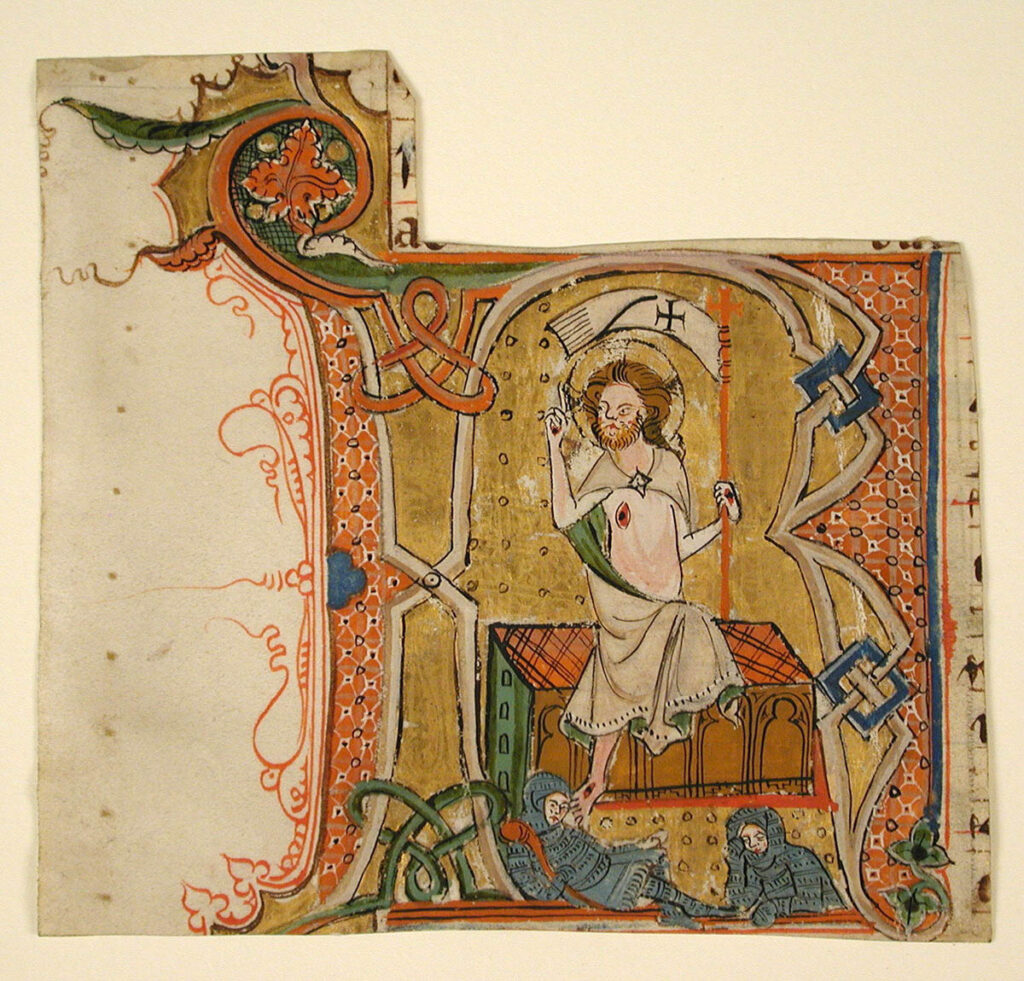
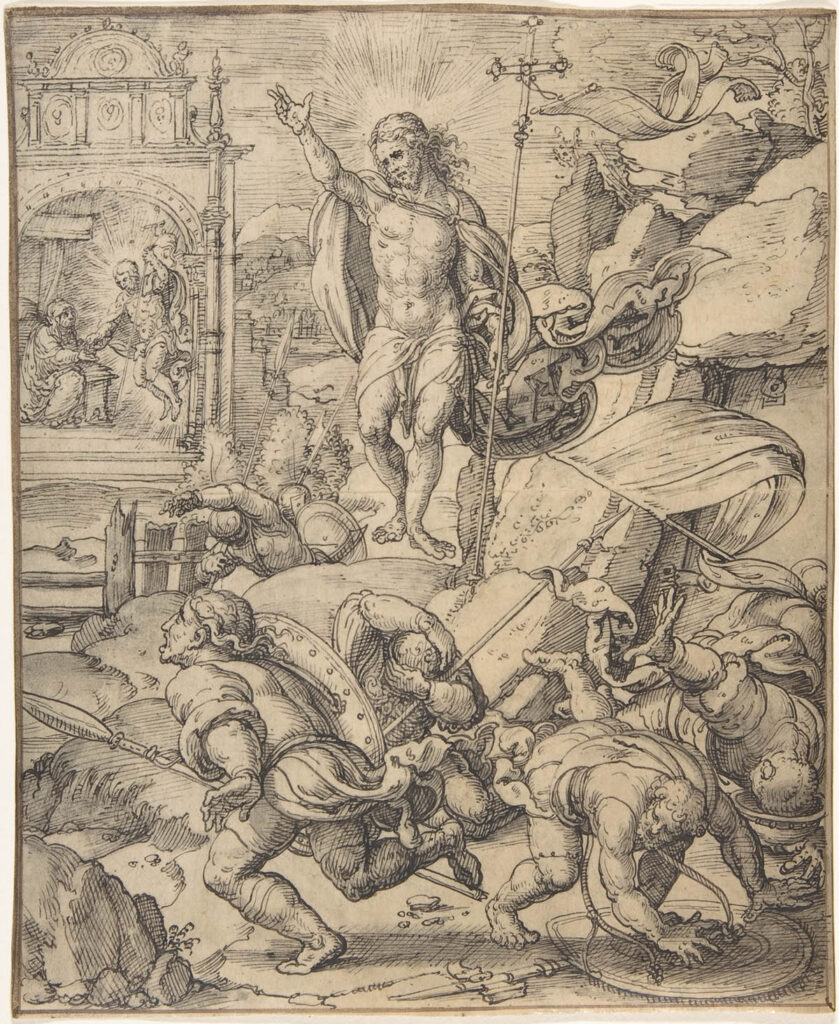
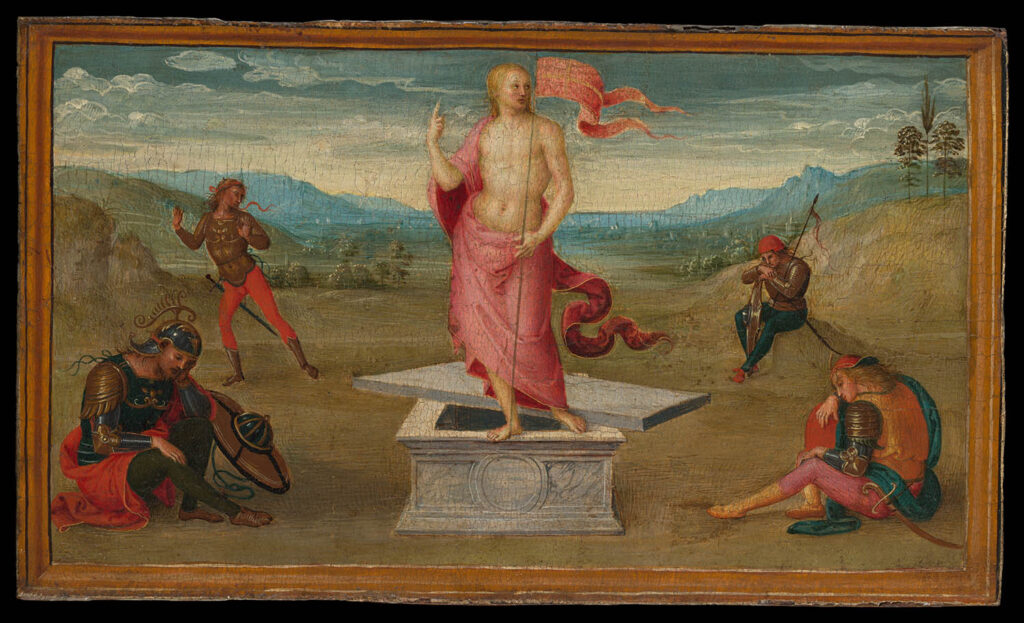
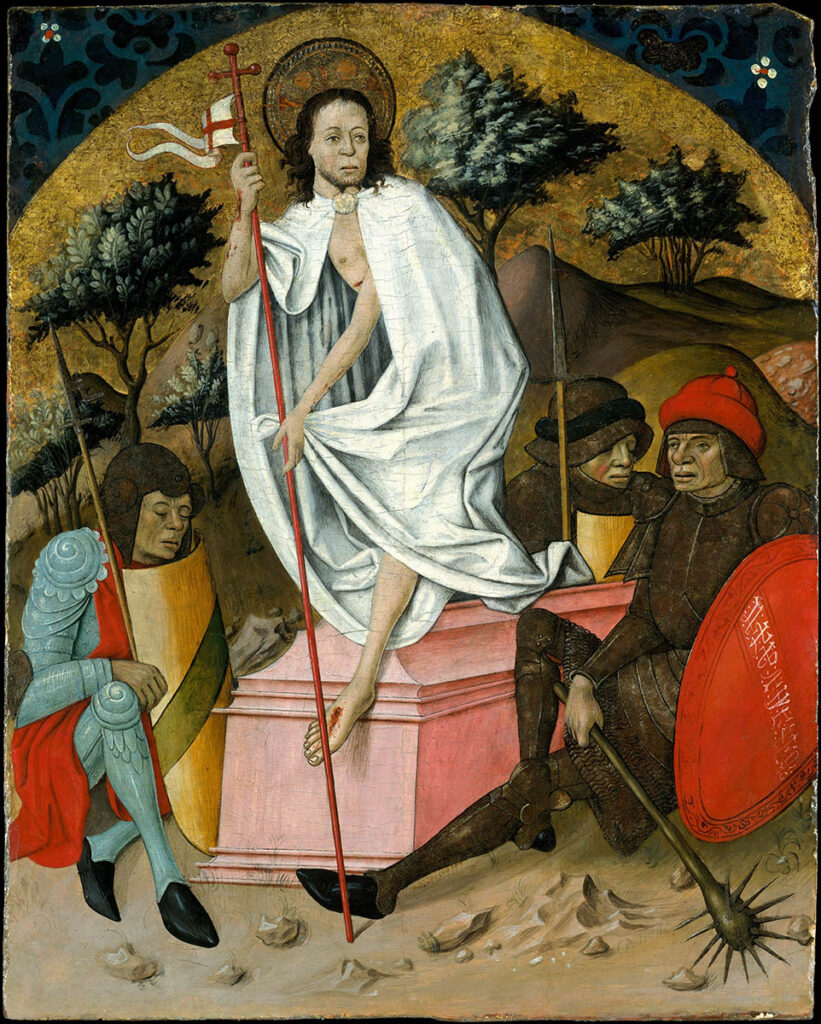
For medieval and early modern artists, it must have been challenging to figure out how to depict the Resurrection. Do you portray Christ as ravaged by his recent torture or as triumphantly over it? What about other people? According to tradition, no one witnessed this event, but any artist who’d already painted a Crucifixion, with crowds milling about and weeping loved ones at the foot of the cross, must have felt odd painting this new scene with no one around, or at least no one awake. What about the lighting? Was it nighttime? The empty tomb was discovered in the early morning, after all. What would Christ have been wearing? So many decisions.
I started pondering this, noticing the Resurrection paintings as they came up in the scrolling amidst all the Crucifixion scenes, and noting the different choices that artists made. Many depictions of this quiet, unwitnessed event are dramatic, even chaotic. Some depict Christ as a buff conqueror who could have struck the same pose if he were emerging from a Roman battlefield. Others have him seeming more tentative, a little scrawny and bedraggled, less fearsome.
In several, artists seem confused about how to render his legs. When you think about it, they probably did not have much experience depicting the human body stepping up and out of something. It’s interesting that they gravitated toward casket-like structures rather than a walk-in burial site. It would have been easier to depict him simply emerging from the cave-like place – body upright, legs in a normal walking position. Some got around this issue by showing him simply standing atop the lid of the sarcophagus or on its edge. A number of Resurrection scenes appear tucked into decorated illuminated capitals rather than in full-page or full-canvas paintings.
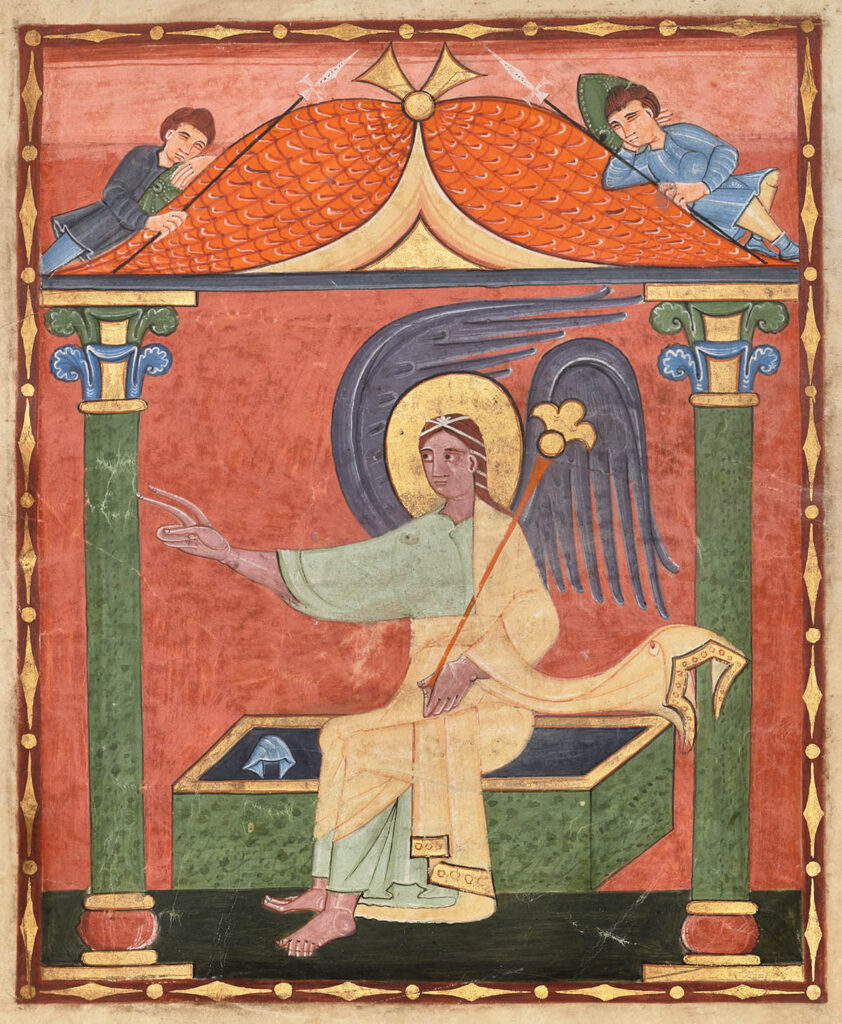
I had seen enough Resurrection paintings by the time my scrolling took me to an eleventh-century image from Germany to recognize how extraordinary it is. The striking color palette belies its quiet simplicity. Christ is not depicted and neither are any other people (except for two sleeping guards, who are above the main scene, not in it). There’s just an angel calmly sitting on the casket and gesturing to the left. So the viewer is cast into the position of one of those arriving at the tomb that morning and hearing from an angel that their loved one wasn’t there. No drama, no fuss, no awkward knees stepping up out of a casket. The moment is quiet but provocative, the image jaw dropping.
I learned that the 15 full-page illustrations in the volume were commissioned by Irmengard of Nellenburg, a noblewoman from the local ruling family, the House of Egisheim-Dagsburg, niece of Emperor Henry II and relative of Pope Leo IX. One of the miniatures in it even depicts her and her then-recently-deceased husband presenting the book to Christ and St. Michael.
I wonder how directive Irmengard was when she made the commission. Did she tell the artist(s?) to use their judgment, or did she say, “This is what I want on a page about Easter morning”? What was her reaction when she saw it? Was it the 11th-century equivalent of scroll stopping for her, too?
She might have felt confident entrusting the volume’s illustration decisions to the artist(s). They were done, after all, at the renowned Benedictine monastery on the island of Reichenau. Founded in 724 on Lake Constance, Reichenau was one of Europe’s greatest centers of learning and culture. In the tenth and eleventh centuries, it was steadily producing lavish manuscripts for elite patrons. The project was in good hands. Reichenau Abbey’s artistic and cultural influence was the subject of 2024 celebrations of the 1300th anniversary of its founding, for which the German postal services even created a stamp.
The Irmengard Codex, which the Getty Museum has dubbed it since excitedly acquiring it in 2023, contains full-page illustrations of the Annunciation, Nativity, Pentecost, and the Ascension, plus all four evangelists hard at work, but not the Crucifixion. The Resurrection is represented by the image of angel sitting on the empty tomb and pointing and by one of the three women on their way to the tomb. You have to admire the cool understatement, even as you take in the anything-but-understated colors.
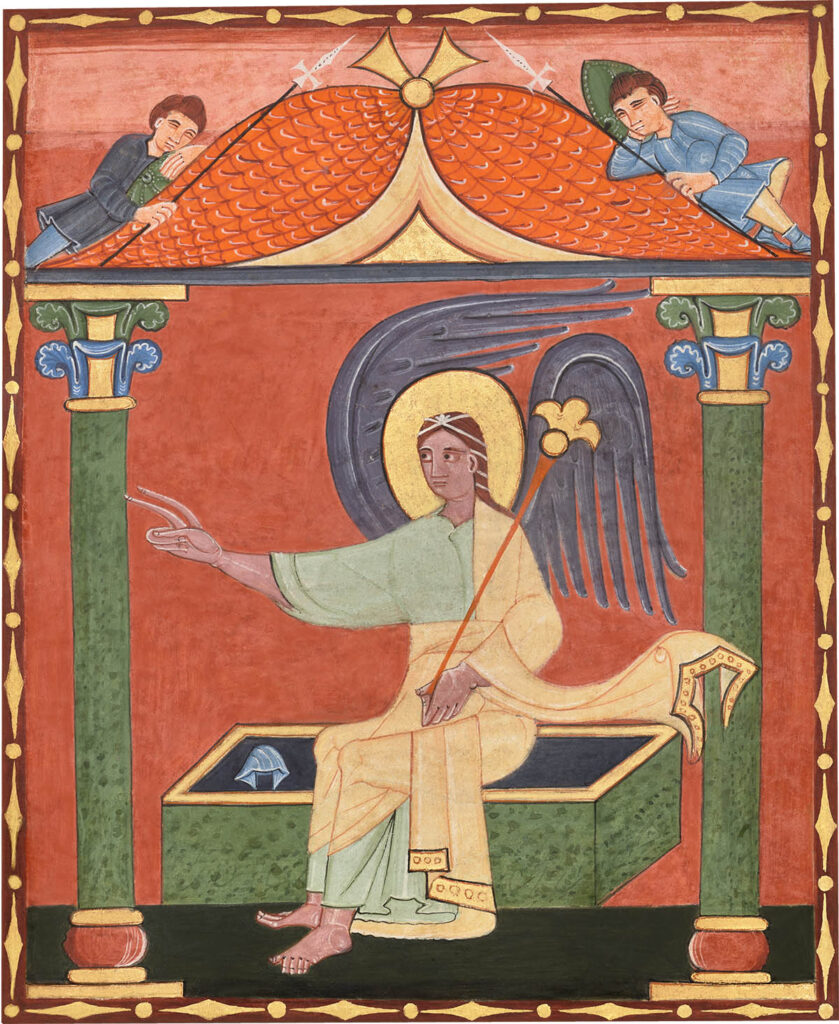
I thought about the illuminators working at the scriptorium at Reichenau every time I opened Photoshop and picked up my stylus and drawing pad to work on this image. It didn’t require a lot of repair work, much less than some others I’ve worked on. I smoothed over some smudges and scratches on the green columns, the cherry (pink? fuchsia?) background, and the angel’s robe and halo, retraced some light lines, re-brightened the gold elongated diamond-like shapes along the border, which had acquired some dirt over the years, and added some more white to the swords of the sleeping guards so they’d show up better in print. Nothing major.
Should I have done more? Or less? I wondered about the colors, too. In this illustration, they’re less pastel-like than other pages in the volume. They’re bolder and brighter. Recent years have seen restoration work on the volume, restoring its pastel colors after some pages had darkened with age. In fact, one report I read said that the Catholic University of Lille, which owned it prior to the Getty’s acquisition, sold it in part because the restoration needs were too complex. This page wasn’t exactly dark, but was it, too, meant to be more pastel? Should I have muted the colors down a notch? Would those incredibly talented illuminators from the scriptorium at Reichenau have approved of my digital restoration choices? I hope so.
I’m pretty sure they’d be awed and thrilled that someone thousands of miles from Lake Constance could view and admire their work and put “brush” to “page” to freshen it up almost 1000 years after they created it.
The wonder of it all!
(Print available here.)